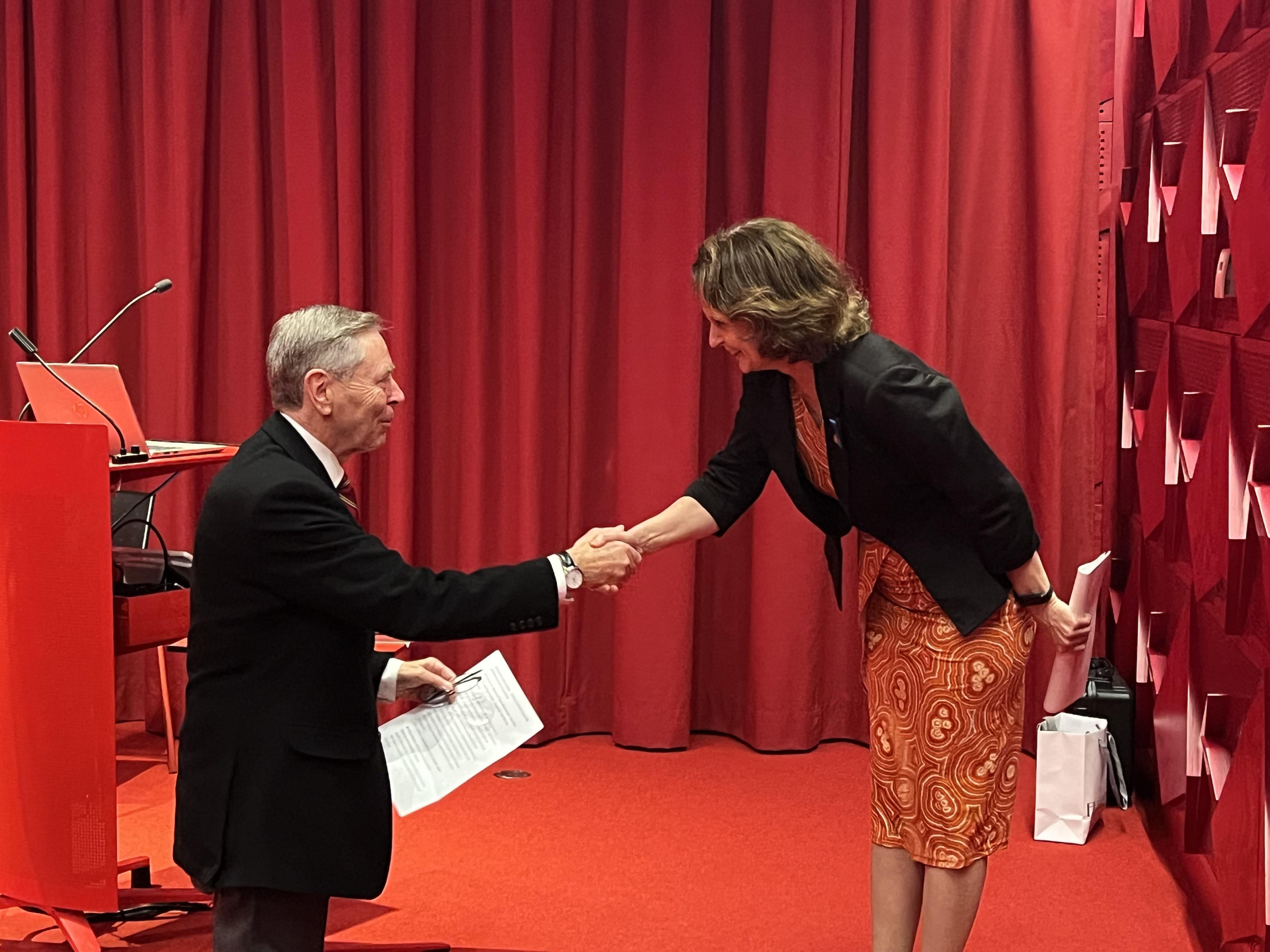
Leadership in Challenging Times
Good morning.
I would like to begin by acknowledging the Bunurong people of the Kulin Nation, the traditional owners of the land on which this Shrine of Remembrance stands and where we gather today.
I also acknowledge and warmly welcome our veterans, current serving members of the Australian Defence Force, honoured guests, community leaders, families, and all those gathered here — and I thank the Rotary Club of Melbourne and the 0808 Committee for organising this annual service to remember the Australian contribution at the Battle of Amiens, and the great Australian leader who commanded the Allied forces there, General Sir John Monash GCMG KCB VD.
Among his many civilian roles, Monash was also a Charter Member and President of the Rotary Club of Melbourne from 1922 to 1923. My thanks to Rotary for inviting me to speak today.
We come together to honour the service and sacrifice of those who fought at the Battle of Amiens on 8 August 1918.
History records Amiens as the great turning point of the First World War — a decisive Allied victory on the Western Front that marked the start of the Hundred Days Offensive which ultimately ended the war. Allied troops from Australia, Canada, Britain and France fought under Monash as one force, and tanks, infantry and aircraft worked together in a genuinely new way of war. It was a bold, surprise attack that shattered the enemy's lines.
But at any commemorative service, we must pause and remember the cost. Amiens helped end a war, but freedom and peace carried a heavy price. Allied casualties exceeded 46,000; German losses were estimated at around 75,000 — a stark reminder of the human cost behind every step toward peace.
I was asked to share my thoughts today on what great Australian leadership looks like, now and into the future and what we can learn from Monash. History often shows us the qualities of great leadership — we simply need to recognise those qualities in the people who can lead us now, and deliberately build that potential in those that can lead in the future.
In my role as Executive Director of the General Sir John Monash Foundation's Leadership Academy, I design leadership programs for John Monash Scholars. The scholarship was first awarded in 2004, and more than 300 have been awarded since. Just as Britain has the Rhodes Scholarship and America has the Fulbright, a group of Australians believed our country deserved its own scholarship — and with Commonwealth Government support, our Foundation was established to deliver it. Scholars are selected on three attributes: excellence, service and leadership — qualities Monash himself embodied, which is why the scholarship carries his name.
Before we turn to Amiens itself, wind the clock back five weeks, to 4 July 1918, and the Battle of Le Hamel, where Monash also commanded Allied forces.
Ninety-three minutes. That is how long it took to win that battle — planned down to the minute, coordinating infantry, tanks, artillery, aircraft and machine guns in a way never attempted before. Monash had promised his superiors ninety minutes. It took ninety-three.
That single fact tells you almost everything about the kind of leader Monash was. I don't want to speak of him this morning as a war hero frozen in bronze on a horse, gazing out over St Kilda Road. I want to talk about how useful he still is to us today — because Monash is a working case study in exactly the kind of leadership Australia needs again today.
Long before Amiens, Monash was a civil engineer, and the habits that made him a great general were built in boardrooms and on construction sites, not in uniform.
In the 1890s and 1900s, Monash became a pioneer of reinforced concrete construction in Australia, at a time when the material was viewed with real suspicion by a profession trained on steel and timber. As managing director of a company building bridges across Victoria in this unproven material, he had to convince sceptical clients, engineers and bankers to trust an unfamiliar technology with their money and the public's safety.
He did it through the same method he later brought to the battlefield: rigorous calculation, careful testing, and a refusal to ask anyone to trust something he had not already proven to himself.
This is why his name sits on our cities, on a university, on our currency, on a medal, and on a Foundation and its scholarships. He was never only a soldier. He was, in sequence and sometimes simultaneously, an engineer, a company director, a lawyer, a musician, a linguist, a university administrator — and, after the guns fell silent, the man who built the electricity grid that powered an entire state for the better part of a century.
An engineer asks "how do we redesign the system so it holds?" It was a habit Monash had practised for two decades before he ever applied it to a battlefield. When he looked at the trench warfare of the Western Front and refused to accept stalemate as simply the price of war, he was treating an intractable problem as a design problem, to be solved through evidence rather than accepted through habit.
If we look at Australia's hardest problems today: housing supply that hasn't kept pace with population growth, an energy grid carrying a renewables transition on infrastructure built for a different century, an aged care system straining under demand, regional communities watching services disappear. None of these are, at bottom, problems of villainy. They are problems of design — badly synchronised systems, misaligned incentives, silos that calcified into habit long ago. The leaders we need are the ones with Monash's instinct, built the way he built it: through years of patient, often unglamorous practice, long before anyone hands them a crisis to solve.
Monash's leadership was tested, not once, but again and again, across several completely different arenas — in each of which failure would have been visible, measurable and permanent. That breadth is exactly why he rewards our attention this morning. We are not here simply to admire a monument. We are here to learn a method — what the founding CEO of my organisation, Ken Crompton, calls "the Monash Method."
He combined attributes I have mentioned, and these are too often kept apart. He had the mind of an engineer and systems thinker who also understood people. He was an innovator, but never for its own sake.
He was highly analytical, yet decisive. He planned meticulously, yet adapted when circumstances changed. He pursued success while recognising an obligation to minimise unnecessary loss of life.
Perhaps most importantly, he understood that leadership was not about personally performing every task. It was about designing and coordinating a system in which thousands of people could succeed together — a distinction that translates remarkably well into contemporary leadership.
So, if we summarise the Monash Method into its 8 aspects it is:
Vision → Courage → Understand the system → Collaboration → Integrity → Planning, Execution and Accountability→ Communication→ Learning.
What does this mean for the leaders of today and tomorrow?
For a modern Australian leader, that might mean approaching health care, energy transition or AI the way Monash approached complex military operations: define the objective clearly; understand the interconnected system in which it operates; assemble the right expertise; use technology intelligently; coordinate stakeholders; anticipate risks; and execute with discipline — while continuing to learn from failure as much as from success.
Now that you have the keys to the Monash Method, I want to leave you with my favourite of his quotes. I genuinely keep it on my fridge at home, because I am passionate about education and life-long learning and believe it is what every Australian leader should aspire to:
"Equip yourself for life, not solely for your own benefit, but for the benefit of the whole community.”
Thank you.